Programs
Each program has its own page with admission details and a link to its requirements in the course catalog.
Data Engineering certificate
An undergraduate certificate you can add to your degree.
Power and Energy Systems certificate
An undergraduate certificate you can add to your degree.
Engineering M.S., electrical engineering concentration
Master's study and research in electrical and computer engineering, full or part time, on a flexible schedule.
Engineering and Applied Science Ph.D.
Doctoral study and research in electrical and computer engineering.
Strong engineering students can earn a master's in less time through the 4+1 accelerated master's program, which moves you from undergraduate to graduate study. The Graduate School runs the program.

Electrical Engineering B.S.E.E.
ABET-accredited, with an optional computer engineering concentration.
Electrical Engineering minor
Add electrical engineering to another major.
Apply and next steps
Not sure how to start? Here's the path, and the offices you may need along the way.
Undergraduate applicants
First-time and transfer students apply through Undergraduate Admissions. If you're transferring or returning, you can request a credit evaluation.
Graduate applicants
Master's and doctoral applicants apply through the Graduate School.
Already have a degree and want undergraduate courses for a pre-professional track? Apply as a non-degree-seeking undergraduate.
Offices you may need
Faculty research areas
Signal, image and data processing
Information fusion and target surveillance
Communications and computer networks
Computing and machine learning
Computer systems and GPU parallel computing
Optics and optical systems, Systems, controls and power
Faculty and research
Faculty at every rank do research with master's and Ph.D. students, and industry partners support many projects. Research now includes more work in computing.

Research labs
Entergy Electric Power Research Laboratory (EN 612)
Power systems and motor control research.
Fiber Optics Laboratory (EN 610)
Fiber optic telecommunications, sensor development and, most recently, remote source lighting and illumination.
High-Performance Computing Laboratory (EN 615)
Deep learning and other computing research.
Information and Systems Laboratory
Target tracking, data fusion, signal detection and machine learning.
Senior design and industry projects
Senior design is a 2-semester capstone with a focus on starting a business. Your team finds a real engineering need, develops a new product idea, tests whether it works and whether it can sell, and turns the idea into a working prototype.
Teams work closely with faculty mentors and industry professionals. Many projects come from industry partners or have an industry sponsor.
Sponsor a project
Companies can sponsor a senior design team. As a sponsor, you may:
- Provide any special equipment the project needs (LSU New Orleans provides standard test equipment)
- Send the sponsor's project description form by the end of the first week
- Attend short progress talks every 2 to 3 weeks
- Attend the final presentation on the day of the scheduled final exam
Sponsor's project description form
Student organizations
The LSU New Orleans branch of the Institute of Electrical and Electronics Engineers (IEEE) promotes the study of electrical and computer engineering.
Teaching labs
Lab work runs through the whole program. You'll start with basic experiments and move on to open-ended design projects, so you build the skill and confidence to solve real engineering problems.
Electrical Circuits Laboratory (EN 716)
12 fully equipped stations with digital and analog oscilloscopes, DC power supplies, function generators and multimeters. You'll design, build and test real circuits and check the theory you learn in lecture. Students usually work in pairs.
Electronics and Communications Laboratory (EN 717)
12 fully equipped stations for the Engineering Electronics Lab and the Communication Systems Lab.
Digital Systems Laboratory (EN 713)
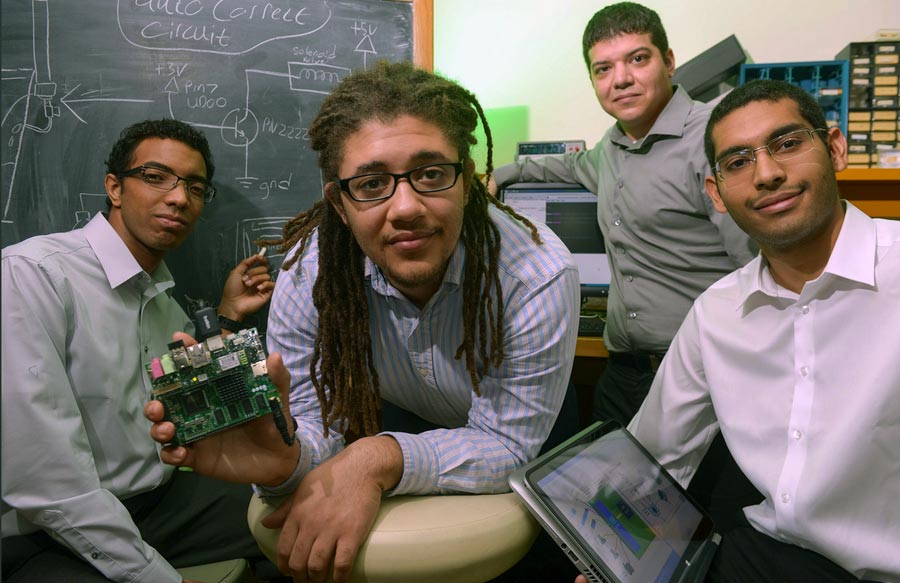
You'll work mainly with analog and digital trainer boxes and FPGA boards, which you check out at the start of the semester.
Senior Design Laboratory (EN 707)
6 stations for senior design students to design, build and test their capstone projects.
Energy Conversion and Power Electronics Laboratory (EN 611)
Hands-on work with power equipment, such as DC and 3-phase AC generators and motors, and power transformers. The experiments mix traditional and current ways of learning about electric machines.
Process Controls Laboratory (EN 618)
8 stations for hands-on work with process control systems and programmable logic controllers (PLCs).
Computer Laboratories (EN 406 and EN 411)
College computer labs for computing courses such as microprocessor design and computer interfacing.