


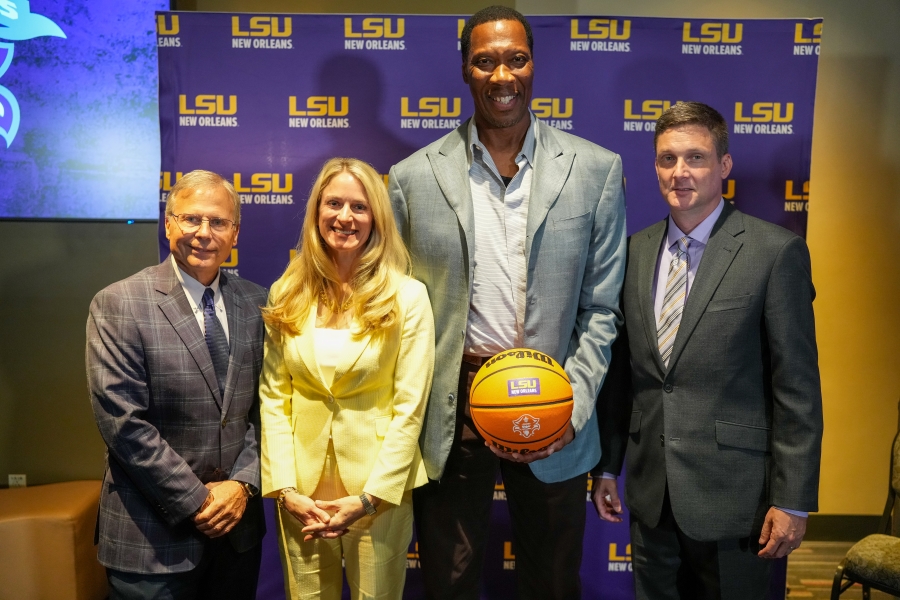
Ervin Johnson, an All-American at the University of New Orleans and a first-round NBA draft pick, has joined the LSU New Orleans men's basketball coaching staff.
The university formally welcomed Johnson back on Friday, August 14, during a press conference at Lakefront Arena, marking a full-circle moment for one of the most accomplished players in Privateer history.
During his four seasons on the Lakefront from 1989-93, Johnson helped lead the Privateers to 87 victories, three conference championships, two NCAA Tournament appearances and an NIT appearance. He established 26 school records and remains the only Privateer selected in the first round of the NBA Draft.
After being selected 23rd overall in the 1993 NBA Draft, Johnson went on to play 13 seasons in the NBA with Seattle, Denver, Milwaukee and Minnesota. He appeared in 845 games during his professional career.
Johnson's No. 40 jersey was retired in 1997, making him the first Privateer to have his number retired and displayed in the rafters of Lakefront Arena. He was inducted into the Louisiana Sports Hall of Fame in 2013 and the Greater New Orleans Sports Hall of Fame in 2018.
Johnson's path to the NBA was anything but conventional. A native of Jonesville, Louisiana, he did not play high school basketball. After arriving at UNO, he walked into then-head coach Tim Floyd's office in 1988 seeking an opportunity, eventually earning a scholarship and becoming one of the greatest players in program history.
By the end of his college career, Johnson had become the Privateers' all-time leader in rebounds, blocked shots and field-goal percentage, while scoring 1,608 points. He was named Sun Belt Conference Player of the Year as a senior after leading UNO to a 26-4 record and an undefeated conference season.
Following his playing career, Johnson devoted himself to mentoring young people, developing athletes, and using basketball as a vehicle to teach hard work, accountability, discipline, teamwork and perseverance. His leadership at the University will play an integral role in mentoring its students and preparing them for success well beyond their time on campus. For LSU New Orleans, his arrival represents both a connection to the program's past and is an investment in its future.