


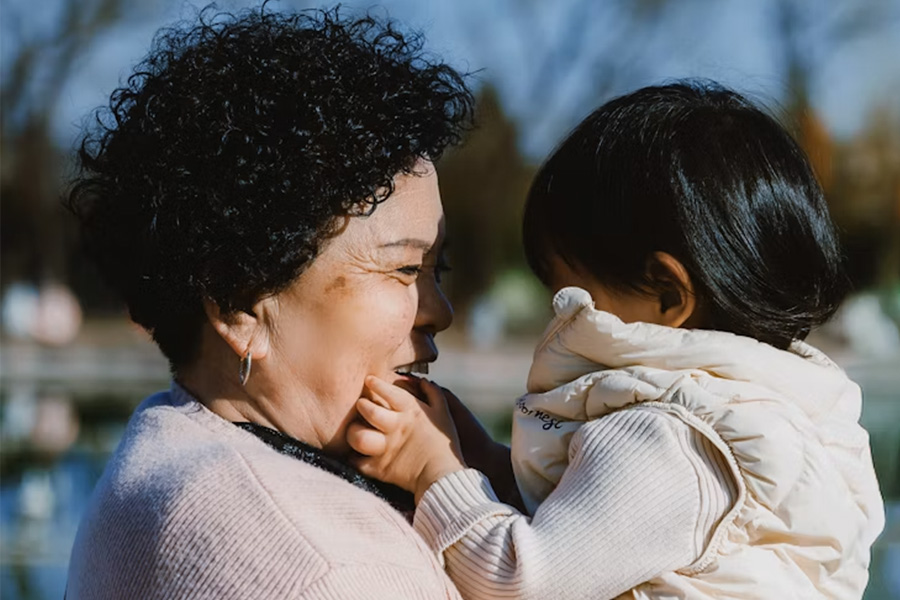
LSU New Orleans researcher Debra Karhson is part of a collaborative research project examining the neurobiological processes that shape relationships between grandparents and their grandchildren.
The project, Wired for Care: Exploring Brain Synchrony and Social Neuromodulators in Multigenerational Families, is supported by a collaborative catalyst grant from the Canadian Institute for Advanced Research (CIFAR). Karhson is working alongside fellow CIFAR Global Scholars Natalie Brito and Guillaume Dumas. Brito is the lead on the project and will oversee the primary site of data collection.
Grandparents play an important role in raising children around the world, particularly in immigrant families and families from diverse racial and ethnic backgrounds. Despite the importance of these relationships, relatively little neurobiological research has examined the social and cognitive connections between grandparents and grandchildren.
The research seeks to help address that gap by examining how differences and similarities in brain function across generations may influence grandparent-grandchild interactions.
Both childhood development and healthy aging involve changes in brain systems as well as shifts in cognitive and social functioning. Some of those changes can follow similar patterns in children and older adults. For example, both groups may exhibit differences in neural activity associated with language processing as well as slower speech rates when compared with young adults.
Other age-related changes, however, may create challenges in communication between grandparents and grandchildren. Children and older adults can both demonstrate reduced verbal fluency and less precise neural responses during language comprehension. These patterns may be related to differences in the cognitive control processes used to maintain, select and update incoming information throughout the lifespan.
As part of the project, Karhson’s lab at LSU New Orleans will primarily analyze saliva samples for social neuromodulators, including oxytocin and anandamide. Her lab focuses on the neurobiology and brain signals associated with pleasure and how those signals help move people from social interaction to social connection.
The collaboration allows Karhson to bring that expertise to a project with Brito and Dumas, whose research focuses on pediatric development. Together, the researchers will explore brain synchrony and social neuromodulators within multigenerational families, contributing to a greater understanding of the neurobiology underlying these important family relationships.
Dumas was also recently named to the Royal Society of Canada’s 2026 class.